
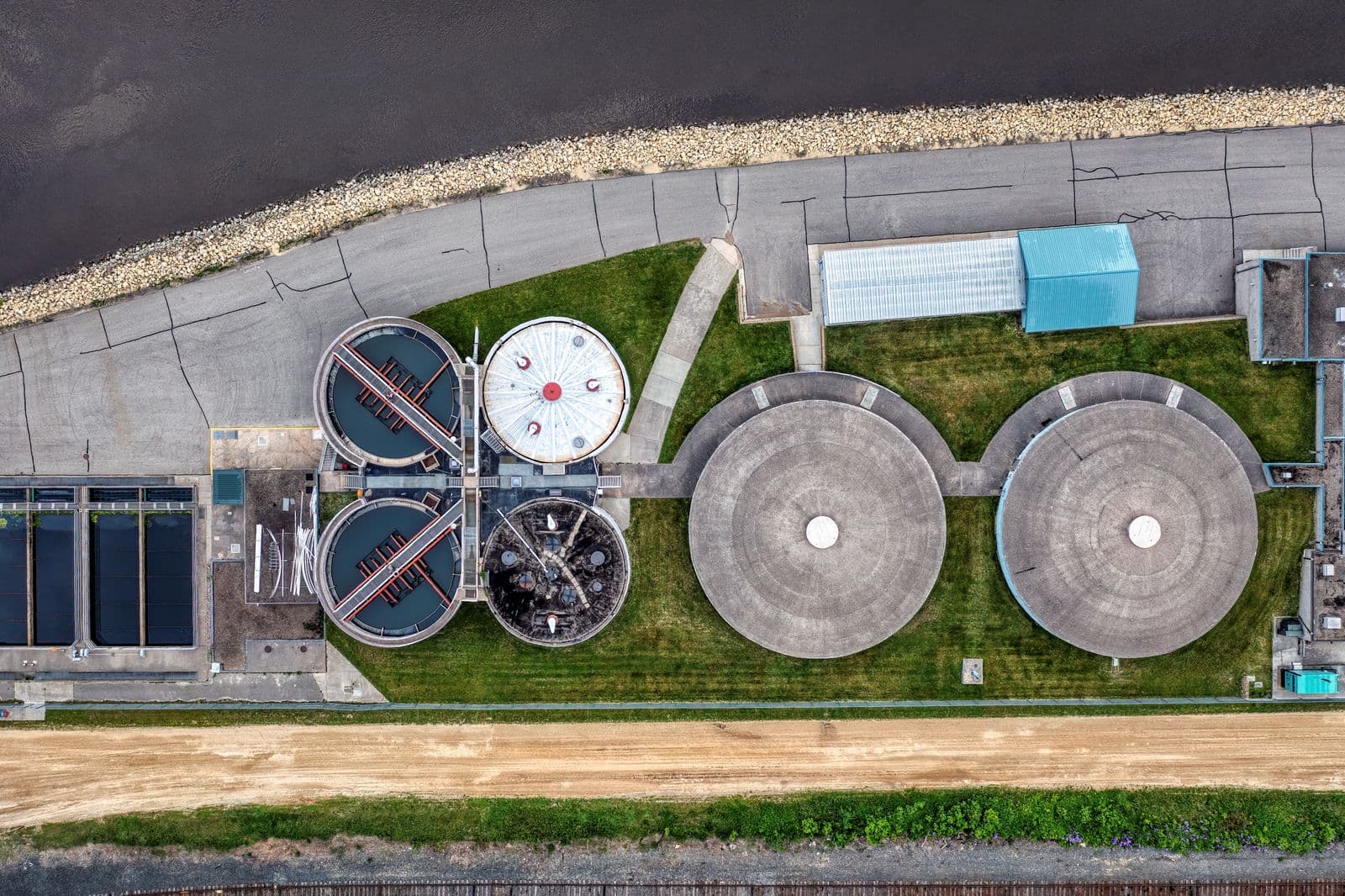
This guide is for water boards, urban local bodies and mission-programme engineers who procure water treatment plants — and for anyone who wants to understand what sits between a river and a tap. The takeaway: a conventional WTP is a chain of water-retaining civil structures in a strict hydraulic sequence, and the civil quality standard that matters most is leak-tightness.
The treatment train, in order
A conventional plant, designed per the CPHEEO Manual on Water Supply and Treatment, moves water by gravity through a fixed sequence:
- Raw water intake — an intake or jack-well at the source, with raw-water pumps and rising mains feeding the plant.
- Aeration and pre-settling (where raw-water quality demands it).
- Coagulation and flocculation — rapid mixing doses coagulant; slow mixing in the clariflocculator builds settleable floc, which the clarifier zone removes.
- Rapid gravity filtration — water percolates through graded sand media in the filter house; periodic backwashing keeps the beds serviceable.
- Disinfection — chlorination sized for contact time before the water leaves the plant.
- Clear water reservoir (CWR) — treated-water storage that buffers plant output against distribution demand, feeding the clear-water pumping station and transmission mains.
The finished water must meet IS 10500, the Indian drinking-water quality standard — that is the number the whole plant is built to deliver.
The civil works that carry the process
Nearly every structure above holds water, which makes IS 3370 (code for concrete structures for storage of liquids) the governing civil standard:
- Clariflocculator RCC — large-diameter circular basins with tight tolerances on the peripheral wall (the scraper bridge rides on it).
- Filter house — filter boxes, under-drain systems and interconnecting channels, plus the operating floor and backwash arrangements.
- Chemical house — storage, dosing rooms and bunded areas for coagulant and chlorine systems.
- Clear water reservoir and sumps — buried or semi-buried water-retaining structures.
- Pump houses — raw and clear-water stations with their substructures and surge arrangements.
Water-retaining concrete demands controlled mixes, disciplined construction joints with water stops, and crack-width-limited detailing. Each basin undergoes a hydrostatic test — filled, held and measured for loss — before any equipment is mounted on it.
The interface discipline: civil meets process
A WTP is delivered jointly by civil and process/mechanical streams, and the schedule risk lives at their interface. Puddle pipes, wall sleeves, embedded plates and pocket dimensions must match the process vendor's drawings exactly — a misplaced puddle pipe in a tested basin is one of the most expensive small errors in water infrastructure. Competent contractors freeze vendor GA drawings before casting, not after.
Commissioning: proving the chain
Commissioning runs in the same order the water flows: leak tests structure by structure, then mechanical trials, then wet commissioning of the full train, and finally stabilisation of output quality against IS 10500 across changing raw-water conditions. Mission-linked schemes (urban and rural water programmes) typically also require the downstream storage and distribution to be ready, so plant handover is planned against the scheme, not just the site fence.
Procurement note: insist on seeing the contractor's water-tightness test records and vendor-drawing coordination procedure. Those two documents predict WTP delivery quality better than any brochure.
Where Valis Infra fits: we deliver complete schemes — intake to distribution — as a water supply and WTP contractor, with water-retaining civil built to IS 3370.