
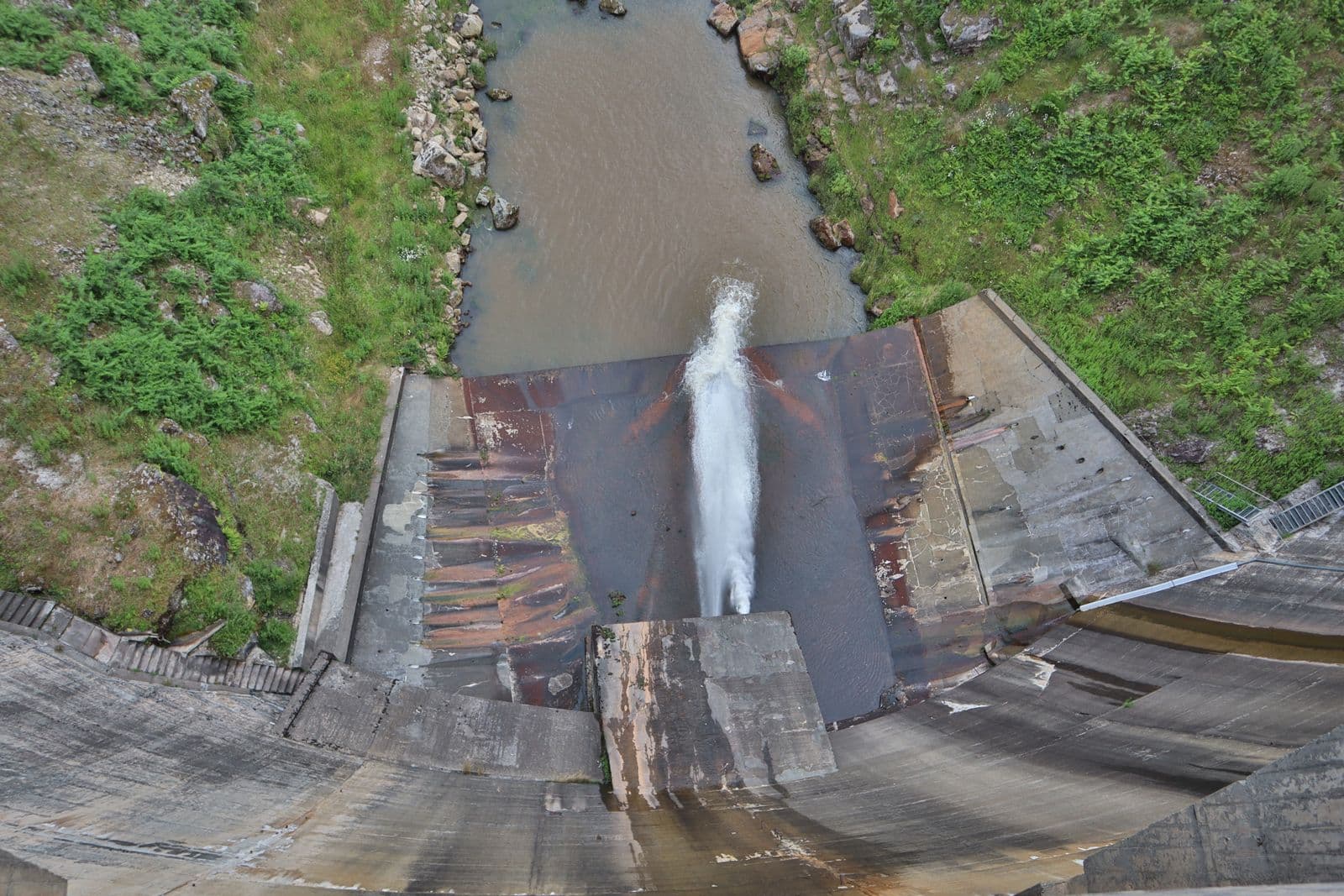
Owners, irrigation departments and reviewers of DPRs regularly face the same headline question: should this dam be an earthen embankment or a concrete structure? This article sets out the real decision drivers and what each choice means for construction. The takeaway: the foundation and the valley decide most of it — the dam type is an answer, not a preference.
What actually drives the choice
- Foundation geology. Concrete gravity dams (designed to IS 6512) need sound rock at reasonable depth to carry high bearing stresses. Earthen embankments tolerate weaker, deeper soils because they spread load over a vastly larger base.
- Valley shape. Narrow, rocky gorges favour concrete; wide valleys make concrete volumes uneconomical and favour embankments.
- Materials availability. An embankment dam is largely built from what can be borrowed nearby — earth, sand, rock fill. Long haul distances change the economics quickly.
- Spillway demand. Flood discharge capacity is fixed by hydrology (spillway capacity per IS 11223). Concrete dams pass floods over their own body; earthen dams must never be overtopped, so they need a separate spillway — often the largest concrete structure on the project.
- Seismicity and settlement. Both types can be engineered for seismic zones, but the analysis, detailing and instrumentation differ materially.
How an earthen dam is built
Design follows the IS guidelines for large earth and rockfill dams (IS 8826). Construction is a materials-handling operation at scale:
- River diversion — coffer dams and a diversion channel or conduit keep the works dry.
- Foundation preparation — stripping, a cut-off trench to an impervious stratum, and curtain grouting where seepage paths demand it.
- Zoned embankment placement — an impervious core (typically compacted clay) flanked by filter and transition zones and outer shells, placed in controlled layers with continuous compaction and moisture testing.
- Protection works — riprap or pitching on the upstream face, turfing downstream, and internal drainage (chimney and blanket drains) to control the phreatic line.
- The separate spillway and outlet works — concrete structures with gates, energy dissipators and stilling basins.
Quality control lives in the earthworks laboratory: gradation, Proctor density, permeability and moisture content, layer after layer.
How a concrete dam is built
A concrete gravity dam is a mass-concrete operation governed by thermal control:
- Block-wise construction — the dam rises as independent monoliths with formed lift joints, later grouted.
- Temperature management — low-heat cement blends, pre-cooled aggregates, controlled lift heights and placement schedules manage the heat of hydration; cracking in mass concrete is a thermal problem before it is a structural one.
- Foundation treatment — dental concrete, consolidation and curtain grouting per CWC and BIS practice.
- Galleries and instrumentation — inspection galleries, drainage holes, and embedded piezometers and plumb lines make the dam observable for its whole service life.
| Factor | Earthen embankment | Concrete gravity |
|---|---|---|
| Foundation | Tolerates soil foundations | Needs competent rock |
| Materials | Local borrow | Cement, aggregates, formwork |
| Spillway | Separate structure required | Integrated overflow section |
| Overtopping | Not tolerable | Tolerable by design |
| Typical cost driver | Haul distance and compaction | Cement content and thermal control |
What both types share
River diversion, a season-locked programme, rigorous foundation treatment, and a commissioning sequence — first filling under a monitored schedule — that is as much a part of the design as the dam section itself.
Where Valis Infra fits: we self-perform both embankment and mass-concrete works as a dams, barrages and irrigation contractor, including spillways, energy dissipators and canal systems.